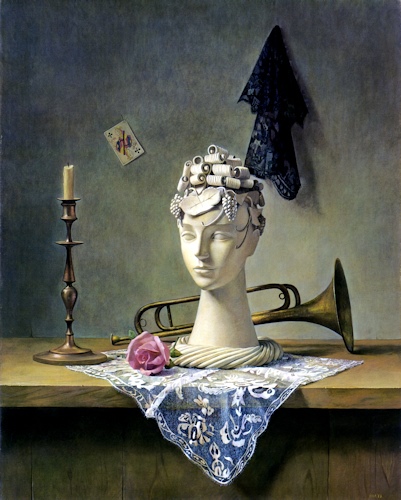
《Lady of the Rose》 1967
《Lady of the Rose》 1967 92.0x73.0cm Oil/Canvas
Due to their beautiful appearance, roses have been beloved in Middle Eastern and Western societies since ancient times, and are associated with Venus, the goddess of beauty and love, and the Virgin Mary. Furthermore, because even delicate roses will eventually wilt and wither, they have also been depicted as symbols of the fleeting nature of beauty and the futility of pleasure.
Joséphine de Beauharnais (1763-1814) was the wife of Napoleon. Failing to produce an heir, she was later divorced and spent her final years at Château de Malmaison, outside Paris. In her later years, she devoted herself to the cultivation and breeding of roses, an achievement that is still celebrated today.
Iwata's 《Lady of the Rose》 is painted using a long-necked plaster statue
as a model, portraying Josephine. She is adorned with curls of grapes and
leaves, like the god of wine, Bacchus. Unlike 《David》, the main focus of
this painting is White Napoleonic-style “Chantilly lace,” creating a pure
and elegant image. A brass instrument is depicted in the background, evoking
the glamorous balls of the past. However, the candle in the tall candlestick
next to it has gone out, representing the transience of the human world
and its rise and fall. Only a single rose remains, conveying to the viewer
the splendor of the past and Josephine's emotions.