《David》 1966~1967
《
David》 1966~1967
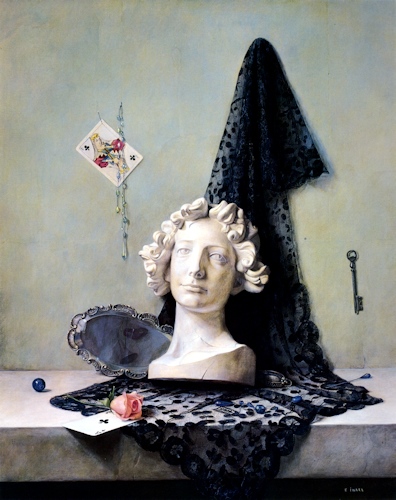
Iwata's 1966 work 《David》 has something in common with his 1967 work 《Lady of Roses》 in terms of the overall atmosphere, the painted plaster statue, lace, and single rose.
The plaster statue is indeed the famous 《David》. It is a replica of the
head of a statue by Andrea Verrocchio (1435-1488) in the Bargello Museum
in Florence. The original gives a youthful and brave impression, but this
plaster statue has a large crack and a dull, worn-out impression. It is
as if it is depicting Napoleon in his later years. The lace depicted here
is “Chantilly lace,” a famous French product revived by Napoleon. It became
known for its intricately woven patterns made from thinner, lighter, fine
bobbin threads and black-dyed silk. Motifs of plants and flowers are bordered
with thick threads. It is luxurious and dignified, and seems to symbolize
Josephine.
So, is this place in Iwata's work the Château de Malmaison? Beside the statue of David, the Ace of Clubs and a rose are placed side by side. And a mask, a remnant of his glamorous and sociable past, is reflected in the mirror. There are also some jewels and the keys to the castle that he was entrusted with. And the owner of the castle is Josephine, whom he relied on until the end. According to historical fact, when Napoleon was exiled to the island of St. Helena, he surrounded himself with photos of Josephine and ate from a plate with her portrait on it. He thought of her until his last moment, and it is said that he muttered her name as his last words before he died on May 5, 1821.
This work is another 《Lady of Roses》. Iwata seems to have painted these two works at almost the same time, or in parallel. While thinking about the bond between the two people.